

 Español
 Português
 لالعربية
 Русский
 Bahasa Indonesia
 Français
 Türkçe
 Bahasa Melayu
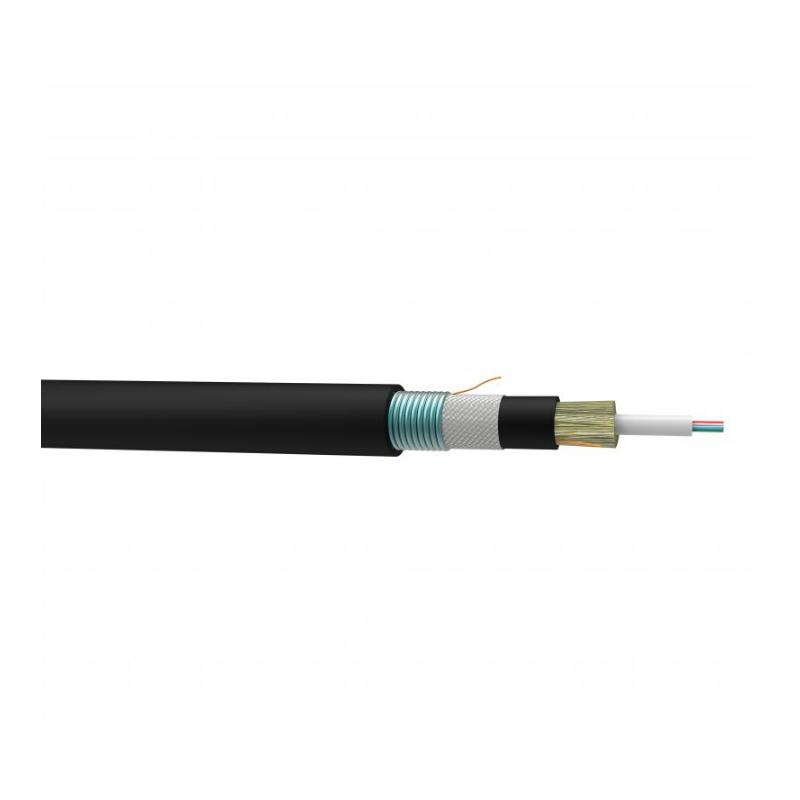
Direct Burial Fiber Optic Cable (DBF) is a high-speed communications backbone designed specifically for harsh underground environments. When connecting individual buildings, establishing campus networks, or deploying long-distance telecommunications lines, this cable can be buried directly into the soil without the need for additional conduit protection, significantly saving time, material, and labor costs.
This article will delve into the unique construction of direct burial fiber optic cables, key types, and proper installation practices to ensure your fiber optic network maintains peak performance and longevity in underground environments.
What is Fiber Direct Burial Cable?
Direct burial fiber optic cable is a rugged, outdoor cable designed to withstand moisture in the soil, chemicals, temperature fluctuations, and mechanical stress from gnawing rodents or accidental digging.
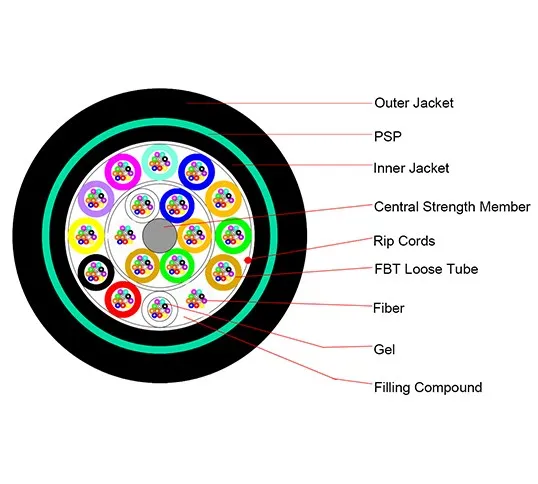
Unlike standard fiber optic cables that need to be laid in conduits, direct buried fiber optic cables are protected by their own multi-layer reinforcement structure. This structure usually includes:
- 1:Rugged Outer Jacket : Typically made of high-density polyethylene (HDPE) or linear low-density polyethylene (LLDPE), it offers excellent resistance to moisture, UV rays, and chemicals.
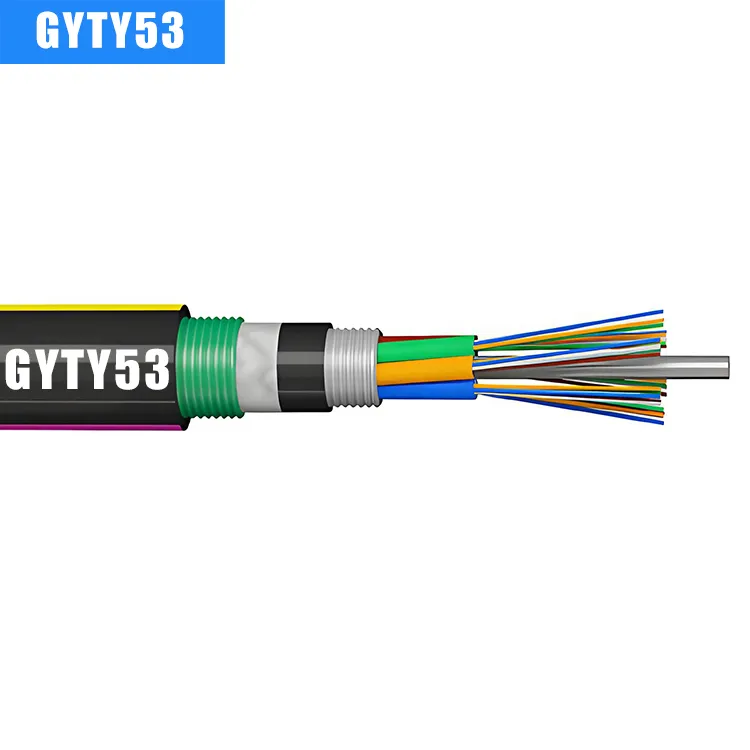
- 2:Armor : This is one of the most important features of direct-burial fiber optic cables. Common armoring materials include corrugated steel tape (CST) or steel wire. The armor provides strong resistance to pressure and rodents.
- 3:Water-Blocking Elements : These include waterproof gels, water-absorbing yarns, or expansion tapes, which prevent moisture from penetrating and migrating along the cable, ensuring that fiber performance is not affected.
- 4:Tensile Strength Members : Such as Kevlar or glass yarn, used to protect the internal fiber bundle from excessive tension during installation.
Structural types and applications of direct buried optical fiber cables
Direct buried fiber optic cables can be divided into various structures according to the packaging method and armor type of the internal optical fibers to meet different application requirements.
1. Common internal structure of optical cables
| Structure Name | Features | Applicable Scenarios |
| Loose Tube | The optical fiber moves freely in the buffer tube, which is filled with gel. The optical fiber has low stress and is more suitable for long-distance and high-fiber-count applications. | Long-distance deployment of telecommunication backbone networks and metropolitan area networks (MANs). |
| Ribbon | The optical fibers are arranged in a ribbon shape with high density. This makes it suitable for ultra-high-core-count optical cables that require large-scale splicing. | Data center interconnection and large-scale access networks. |
| Tight Buffered | The optical fiber is directly coated with a 900µm protective layer. It is easy to terminate on site and is suitable for branching or shorter distance connections. | Campus network and building-to-building interconnection. |
2. Comparison of armor types (most common direct burial protection)
| Armor type | advantage | shortcoming | Applicable environment |
| Non-Metallic | Light weight, easy to install; non-conductive, no grounding requirement; strong moisture resistance. | Not as resistant to crush and rodents as steel belt armor. | Slight rodent risk, non-high mechanical stress environment. |
| Corrugated Steel Armor (CST Armored) | Excellent resistance to pressure and rodents, it is the first choice for direct burial optical cables. | It is heavier, and grounding needs to be considered during installation; it has slightly higher rigidity. | Areas with high rodent risk and potential disturbance from heavy machinery. |
Installation methods and safety specifications for direct buried optical cables
The installation of direct buried fiber optic cables should strictly follow industry specifications and local regulations to ensure the long-term reliability of the network.
1. Installation Method
There are two main methods for laying direct buried optical cables:
- 1: Trenching : A trench is dug using an excavator or manually. This method is suitable for areas with complex terrain, a large number of existing underground facilities, or where precise depth control is required.
- 2: Plowing : Using special plowing equipment, the cable is buried directly underground without digging up the entire surface. This method is fast and inexpensive and is suitable for open, flat areas without obstructions.
2. Key safety and depth requirements
Like power cables, fiber optic cables also have specific burial depth requirements (always consult local regulations, such as the NEC):
- 1: Depth : While fiber optic cables are not subject to the same minimum depth requirements as power cables under the NEC, industry standards generally recommend a burial depth of approximately 24 inches to prevent damage from routine farming or digging activities.
- 2:Line Detection : Before any excavation work begins, it is important to contact a local utility locating service (such as Underground Utility Detection) to mark all existing electric, gas, and water lines.
- 3:Warning tape : When backfilling, a metal warning tape should be buried approximately 12 inches above the fiber optic cable to allow future maintenance personnel to locate the fiber optic cable using a metal detector to avoid accidental cutting.
- 4:Slack : Sufficient cable slack (often called "snake-off") should be allowed during installation to account for cable contraction or stretching caused by soil settlement and temperature changes.
- 5:Minimum bend radius : During installation, never bend the cable beyond the minimum bend radius specified by the manufacturer, especially where the cable enters the splice box or building, as this may result in increased fiber loss or breakage.
5 Frequently Asked Questions (FAQs) About Fiber Direct Burial Cable
Q1: Does direct buried optical cable need to be grounded?
A1: If you are using a direct-buried optical cable with metal armor (such as corrugated steel tape), its metal components are conductive. Safety regulations require grounding on both sides or within a specified distance to protect the cable from damage from lightning strikes or high-voltage induced currents. Non-metallic optical cables do not require grounding.
Q2: What are the advantages and disadvantages of direct buried optical cables compared to optical cables running in ducts?
A2:
- Advantages : Low cost and fast installation (no need to purchase and install conduit), ideal for projects with limited budgets or long distances.
- Disadvantages : Once installed, it is difficult to repair and replace; when upgrading the network in the future, it is not possible to easily pull out old cables and pull in new cables as with a duct system.
Q3: What is the function of the gel or waterproof tape in the optical cable?
A3: They are the core of waterproofing. If the cable's outer sheath is accidentally damaged, the waterproof gel or water-swelling tape immediately prevents moisture from penetrating and spreading along the fiber optic bundle. Moisture penetrating the fiber can cause signal attenuation and, in severe cases, communication interruption.
Q4: Why is single-mode optical fiber usually recommended for direct-burial optical cables?
A4: Direct-burial fiber optic cables are primarily used for long-distance outdoor transmission, such as connecting cities or buildings. Single-mode fiber (SMF) offers lower attenuation and higher bandwidth capacity, enabling it to transmit signals over longer distances at a lower cost. This makes it the preferred choice for most outdoor backbone networks and long-distance direct-burial applications.
Q5: Can I use standard indoor/outdoor fiber optic cables for direct burial underground?
A5: Absolutely not. Standard indoor/outdoor fiber optic cables (such as riser-grade or general-purpose cables) lack the armor and heavy-duty waterproof jackets typical of direct burial cables . They cannot withstand soil corrosiveness, moisture penetration, and rodent damage, which will cause the cables to fail quickly. You must use OSP (Outside Plant)-grade fiber optic cables clearly marked "Direct Burial" or with steel tape armor.


