

 Español
 Português
 لالعربية
 Русский
 Bahasa Indonesia
 Français
 Türkçe
 Bahasa Melayu
1. What is a Fiber Optic Patch Cord?
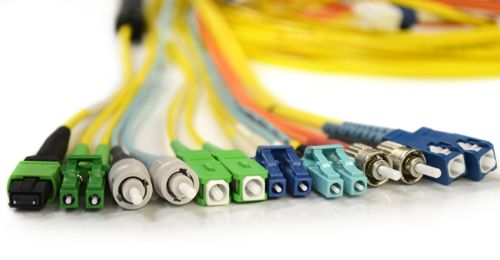
Fiber optic patch cables, also known as fiber optic cables (Fiber Cords), are fixed-length optical cables with fiber optic connectors (such as SC, LC, ST, FC, etc.) installed on both ends. They are used to provide flexible connections or patching between devices and components in fiber optic communication systems.
Key components:
- 1:Fiber Optic Cable: The core part that transmits optical signals.
2:Fiber Optic Connector: Fixed at both ends of the optical cable and used to connect devices.
2. Fiber Patch Cable Core Type: Single-Mode vs. Multimode
2.1 Single-Mode Fiber Cords (SMF)
- 1:Features: The fiber core diameter is small (usually 9μm/125μm), allowing only one light mode to be transmitted.
- 2:Coat color: Usually yellow .
- 3:Application scenarios: Suitable for long-distance , high-speed data transmission, such as telecommunications, large data centers and CATV networks.
2.2 Multi-Mode Fiber Cords (MMF)
- 1:Features: The fiber core diameter is large (such as 50μm/125μm or 62.5μm/125μm), allowing transmission of multiple light modes.
- 2:Coat color: OM1/OM2 is usually orange or gray ; OM3 is aqua ; OM4 is erika violet; OM5 is lime green .
(Note: The color of the fiber optic patch cord's jacket is the key to distinguishing its mode. For example, single-mode is usually yellow, while multimode varies according to its grade (such as OM3 is aqua blue). For detailed color coding, please refer to the industry's authoritative fiber optic color coding standard (TIA-598-C) . )
- Application scenarios: Suitable for short-distance , high-bandwidth transmission, such as local area networks (LANs) and internal connections in small data centers.
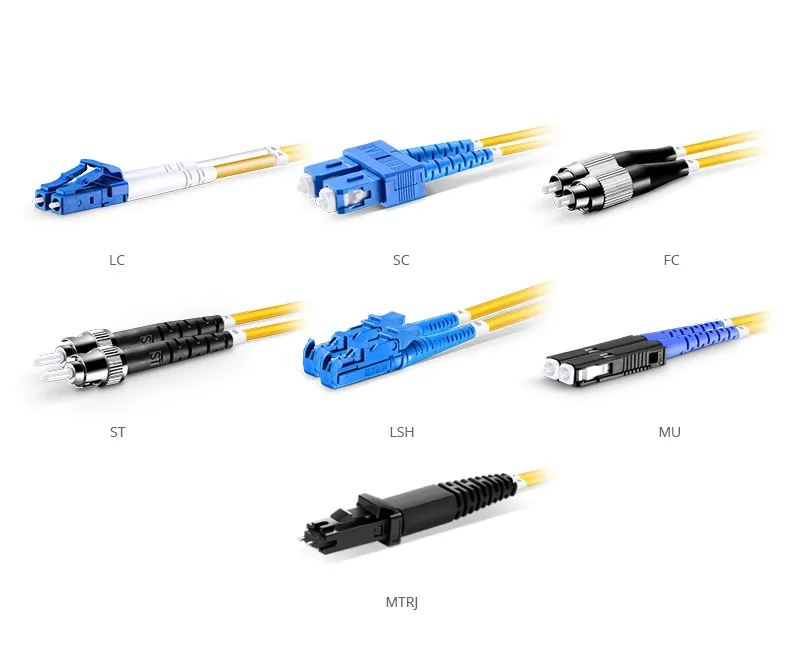
3. Detailed Explanation of Common Fiber Optic Connector Types
(Use tables or lists to clearly present and improve information acquisition efficiency)
| Connector Type | Appearance Features | Common Applications |
| LC | Small, push-pull buckle, high density | Data center, high-density distribution frame |
| SC | Square, push-pull plug | Telecommunications, FTTH (Fiber to the Home), Data Centers |
| ST | Round, bayonet connection (BNC style) | Earlier network equipment, industrial environment |
| MTP/MPO | Multi-core (8/12/24 cores), high-density pre-terminated | 40G/100G/400G high-speed networks |
All high-quality fiber optic patch cord products should strictly follow international standards for connectors and performance, such as IEC 61754 (connector family standard) and TIA/EIA 604 (FOCIS) specifications, to ensure interoperability and reliability.
4. Classification by transmission mode
- 1:Simplex: There is only one optical fiber and it can only transmit in one direction.
- 2:Duplex: There are two optical fibers for bidirectional transmission (one for sending and one for receiving).
5. How to choose the right fiber optic patch cord?
- 1:Determine the fiber mode: Select single-mode (SM) or multi -mode (MM) (such as OM3/OM4) based on the transmission distance and speed requirements .
- 2:Match the connector type: Make sure the connector type (such as LC-SC, LC-LC) on both ends of the patch cord exactly matches your device interface .
- 3:Determine the connector polish type (Polish Type):
- A: PC/UPC: physical contact/ultra-physical contact (commonly used in multimode and some singlemode).
- B: APC: Angled physical contact (commonly used in single mode, especially in FTTH, to minimize return loss).
- 4:Select jacket material: LSZH (Low Smoke Zero Halogen) is suitable for indoor public areas; OFNR/OFNP is suitable for risers/vents.
5:Consider bend-insensitive fiber (BIF): In scenarios where cabling space is limited or there are large bends, choosing BIF patch cords can reduce loss.
6. FAQ
Q1: Can single-mode and multi-mode fiber optic patch cables be mixed?
A: No. The optical signal from a single-mode device cannot be effectively transmitted in a multimode fiber, and vice versa, resulting in severe signal loss or connection failure.
Q2: How do I tell if my fiber optic patch cable is single-mode or multi-mode?
A: The easiest way is to look at the jacket color: yellow is usually single mode; orange/aqua/lime green are usually multimode.
Q3: Can UPC and APC connectors be connected to each other?
A: Not recommended. Due to the different polishing angles (UPC is 0 degrees, APC is 8 degrees), direct connection will result in extremely high insertion loss and permanent damage.


