

 Español
 Português
 لالعربية
 Русский
 Bahasa Indonesia
 Français
 Türkçe
 Bahasa Melayu
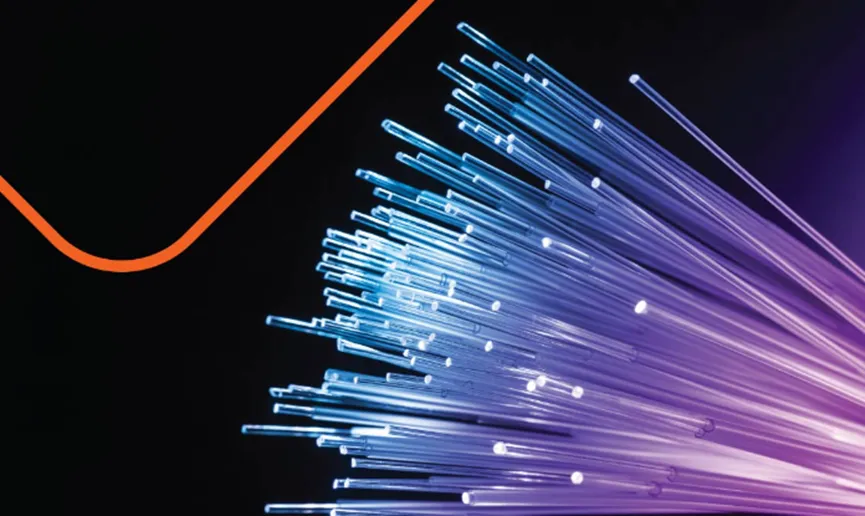
Fiber optic technology represents a revolutionary advancement in telecommunications. It operates on a fundamentally different principle from conventional metal-based systems by transmitting light rather than electrical energy. The fiber optic strand serves as a passive conduit for this light and is not itself an electrical source.
Fiber optic communication networks provide consistent, premium data transfer speeds without the signal degradation over distance that affects traditional technologies like cable broadband and DSL. However, these high-performance networks are characterized by greater cost, which in turn limits the scope of their deployment.
Pros of Fiber Optics
1) Fiber optics provide superior connection quality, characterized by a low bit error rate. This is largely thanks to their immunity to electromagnetic interference (EMI)—a form of external disturbance that often degrades conventional metal cables. Since optical fibers are non-metallic and immune to corrosion, they remain unaffected by EMI sources like power lines.
2) Fiber optic networks are inherently scalable, facilitating seamless network expansion. This is achieved by dynamically activating new wavelengths and upgrading terminal equipment, allowing businesses to scale bandwidth on demand. The compact size of the fibers also enables efficient future-proofing, as ducts can be pre-equipped with ample capacity for 15-20 years of growth, deferring the cost of subsequent installations.
3) Fiber optics address the paramount concern of security through inherent physical properties. Since they emit no electromagnetic radiation, signal transmission is inherently secure against eavesdropping. Any physical breach is instantly detectable due to complete system failure. Moreover, network architecture can be simplified by consolidating hardware in a central, secured location, thereby streamlining access control and maintenance protocols.
4) Despite a substantial upfront cost, fiber optics prove to be more cost-effective long-term. They not only incur lower operational overhead than copper networks and possess unparalleled scalability that justifies the initial investment, but the technology is also projected to become more affordable as its adoption expands.
Cons of Fiber Optics
Fiber optic networks are not without their limitations. Key disadvantages that must be considered include susceptibility to physical damage, significant upfront investment, specific structural requirements, and the potential for a "fiber fuse" phenomenon.
1) While their small size and light weight are advantages, fiber optic cables are more fragile than metallic wiring. They are vulnerable to accidental cuts during construction, and due to their high data capacity, a single break can disrupt service for many users. Additionally, they are sensitive to sharp bends, radiation, and chemical exposure.
2) The short-term cost of implementing fiber optics is high. This includes the expense of specialized installation, skilled labor, and the advanced equipment needed for both setup and troubleshooting, making initial deployment and any repairs a significant investment.
3) At high power levels, fiber optics networks are vulnerable to a "fiber fuse." This phenomenon is triggered when a high-intensity light signal encounters a flaw in the cable, potentially destroying long segments almost instantaneously.
4) Fiber optic cables are confined to transmitting light in a single direction. Consequently, achieving full-duplex operation—simultaneous two-way communication—requires the installation of two separate cables.


