

 English
 Español
 Português
 لالعربية
 Русский
 Français
 Türkçe
 Bahasa Melayu
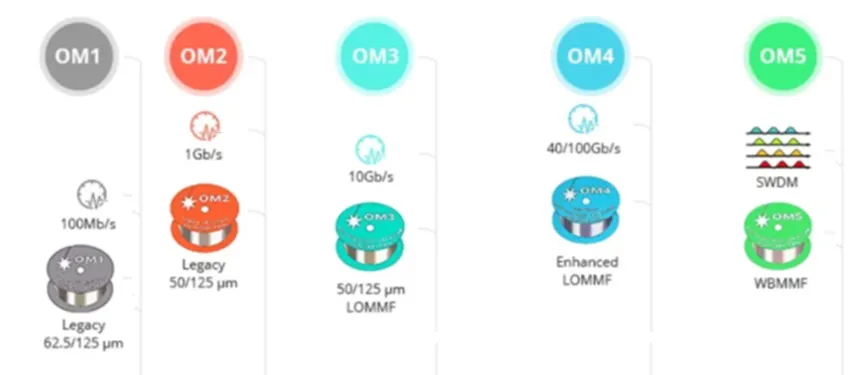
Serat multimode adalah jenis serat yang digunakan untuk transmisi jarak pendek dan umumnya ditemukan di jaringan kampus, LAN perusahaan, dan pusat data. Saat ini, lima jenis serat multimode yang tersedia di pasaran antara lain OM1, OM2, OM3, OM4, dan OM5, masing-masing dengan kemampuan transmisi data yang bervariasi. Dengan begitu banyak jenis serat multimode, apakah Anda kewalahan dengan pilihannya? Artikel ini akan fokus pada perbedaan serat OM1, OM2, OM3, OM4, dan OM5. Kami percaya bahwa setelah membaca artikel ini, Anda akan memiliki pemahaman yang lebih jelas tentang proses pemilihan serat multimode.
Jenis dan perbedaan serat multimode
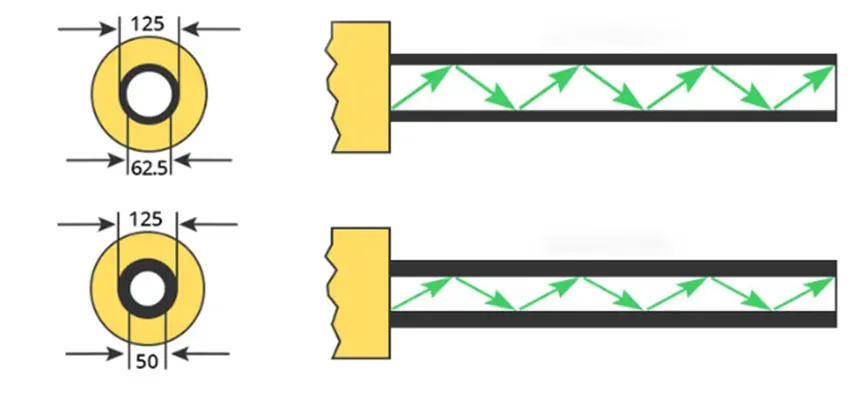
Dibandingkan dengan serat optik mode tunggal, serat optik multimode memiliki diameter inti yang lebih besar, biasanya 50μm atau 62.5μm, dan mendukung propagasi mode optik ganda. Menurut standar ISO 11810, serat optik multimode dibagi menjadi serat optik OM1, OM2, OM3, OM4 dan OM5.
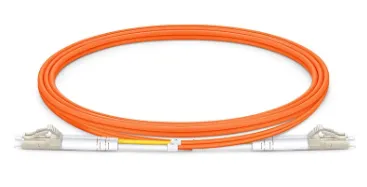
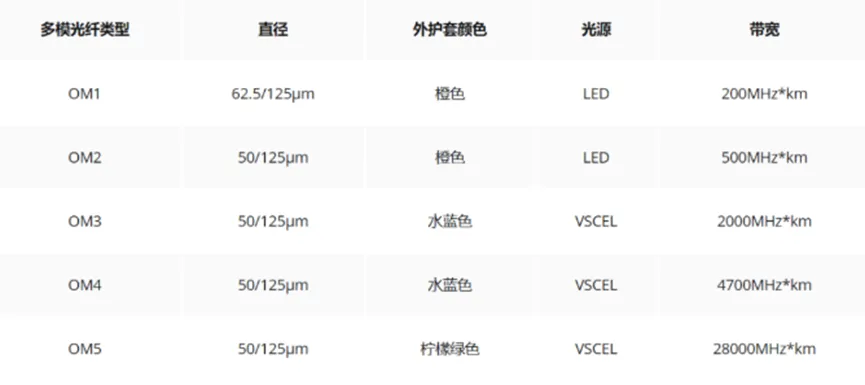
Serat OM1 mengacu pada serat multimode dengan jendela injeksi penuh 850 / 1300nm dan bandwidth 200 /500MHz.km atau lebih tinggi. Ini menggunakan sumber cahaya LED, memiliki diameter inti 62.5μm, dan biasanya dilapisi oranye. Ini dapat digunakan untuk kecepatan Ethernet di bawah 10Gbps dan paling umum digunakan dalam 100M Ethernet. Karena diameter intinya yang lebih besar, serat OM1 memiliki kemampuan mengumpulkan cahaya yang lebih kuat dan lebih tahan terhadap pembengkokan.
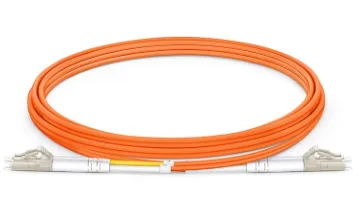
Serat OM2 mengacu pada serat multimode dengan jendela injeksi penuh 850 / 1300nm dan bandwidth 500 /500MHz.km atau lebih. Ini menggunakan sumber cahaya LED, memiliki diameter inti 50μm, dan biasanya dilapisi oranye. Ini dapat digunakan untuk layanan Ethernet hingga 10Gbps dan paling umum digunakan di Gigabit Ethernet. Dibandingkan dengan serat OM1, serat OM2 memiliki diameter inti yang lebih kecil, secara efektif mengurangi dispersi modal serat multimode, menghasilkan peningkatan bandwidth dan sepertiga pengurangan biaya produksi.
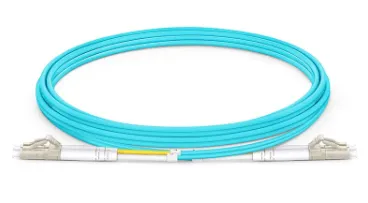
Serat OM3 adalah serat multimode yang dioptimalkan dengan laser. Ini menggunakan sumber laser VCSEL 850nm, memiliki diameter inti 50μm, dan selubung luar biru aqua. Ini dapat digunakan untuk kecepatan transmisi Ethernet di bawah 100Gbps dan paling umum digunakan dalam 10GbE. Dibandingkan dengan serat OM1 dan OM2, OM3 menawarkan kecepatan transmisi dan bandwidth yang lebih tinggi, dan oleh karena itu juga dikenal sebagai serat multimode yang dioptimalkan atau serat multimode 10GbE yang dioptimalkan.
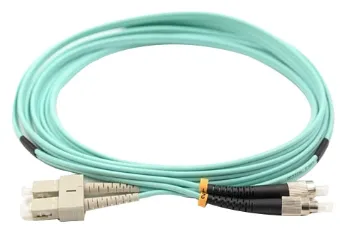
4. Serat OM4 adalah versi upgrade dari serat multimode OM3, menawarkan kinerja yang unggul. Misalnya, serat OM4 menawarkan lebih dari dua kali lipat bandwidth efektif serat OM3 dan kompatibel dengan serat OM3. Selubung luarnya berwarna biru aqua. Dalam jaringan Ethernet melebihi 10Gbps, serat OM4 dapat mengirimkan lebih jauh dari serat OM3, mencapai hingga 400 meter.
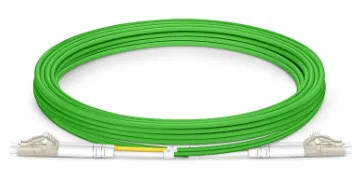
5. Serat OM5 adalah serat multimode broadband yang baru diluncurkan yang kompatibel dengan serat OM4. Diameter intinya sama dengan serat OM2 / OM3 / OM4 (50μm) dan selubung luarnya berwarna hijau lemon.
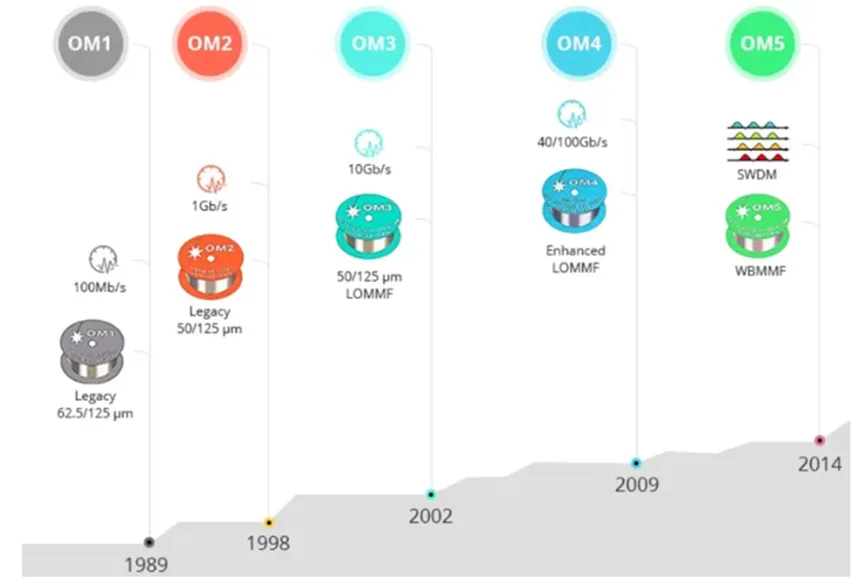
Singkatnya, perbedaan terbesar antara serat optik multimode OM1, OM2, OM3, OM4 dan OM5 terletak pada perbedaan fisika dan aplikasi.
1. Perbedaan fisik
Serat optik multimode yang berbeda memiliki perbedaan fisik yang berbeda, terutama tercermin dalam diameter, warna selubung luar, sumber cahaya dan bandwidth, seperti yang ditunjukkan pada tabel berikut:
2. Perbedaan Aplikasi
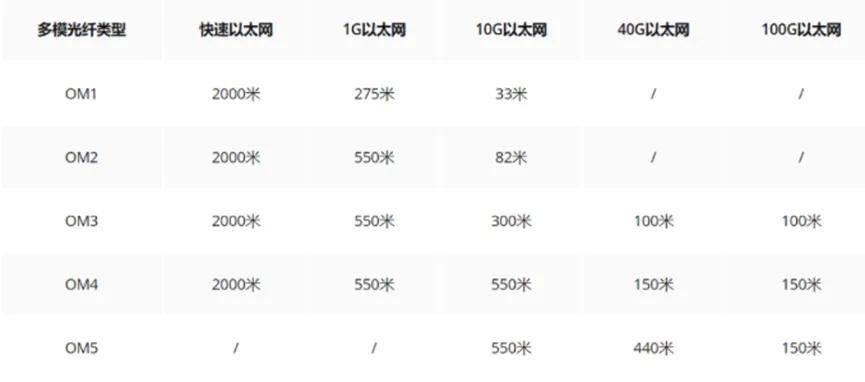
Serat optik multimode yang berbeda digunakan dalam jaringan Ethernet yang berbeda dan mendukung jarak transmisi maksimum yang berbeda, seperti yang ditunjukkan pada tabel berikut:
Tren Pengembangan dan Aplikasi Serat Multimode
Didorong oleh tuntutan aplikasi jaringan berkecepatan tinggi, serat multimode berkembang menuju kerugian rendah, bandwidth tinggi, dan multiplexing multi-panjang gelombang. Dengan kemajuan teknologi serat yang berkelanjutan, serat multimode telah berevolusi dari serat OM1 asli ke serat OM5 saat ini yang mendukung jaringan 40 / 100G, menawarkan kinerja yang lebih baik.
Saat ini, serat multimode OM1 dan OM2 terutama digunakan untuk tautan Ethernet 1G di dalam ruang komputer, sedangkan serat multimode OM3 dan OM4 terutama digunakan untuk kabel serat pusat data 10G / 40G. Serat multimode OM5 cocok untuk transmisi tautan Ethernet berkecepatan tinggi 40G / 100G. Dibandingkan dengan serat multimode OM1 / OM2 / OM3 / OM4, serat multimode OM5 menawarkan skalabilitas dan fleksibilitas yang lebih besar, mendukung transmisi jaringan berkecepatan lebih tinggi dengan jumlah serat yang lebih kecil. Biaya dan konsumsi dayanya secara signifikan lebih rendah daripada serat mode tunggal. Ini menunjukkan bahwa serat multimode OM5 kemungkinan akan digunakan secara luas di pusat data 100G / 400G / 1T ultra-besar di masa depan.
FAQ tentang Serat Multimode
1. Apa perbedaan antara serat multimode dan serat mode tunggal?
Diameter inti: Serat multimode memiliki diameter inti yang lebih besar (biasanya 50/62.5 μm) dan dapat mengirimkan beberapa mode cahaya. Serat mode tunggal memiliki diameter inti yang lebih kecil (biasanya 9 μm) dan hanya dapat mengirimkan satu mode cahaya.
Bandwidth: Bandwidth serat mode tunggal biasanya lebih tinggi daripada serat multimode, dan bisa setinggi 100.000 GHz.
Sumber cahaya: Serat optik multimode umumnya menggunakan sumber cahaya LED, sedangkan serat optik mode tunggal umumnya menggunakan sumber sinar laser.
Distance: Serat multimode cocok untuk aplikasi jarak pendek, dan jarak transmisi maksimum biasanya dapat mencapai 550m.
Biaya: Serat multimode umumnya harganya lebih murah daripada serat mode tunggal.
2. Jenis konektor serat optik multimode
Saat ini, konektor serat optik multimode umum (yaitu, konektor) termasuk konektor ST, SC, FC, LC, MU, E2000, MTRJ, SMA, DIN, dan MTP & MPO. ST, SC, FC, LC, dan MTP / MPO adalah jenis konektor serat optik yang paling umum digunakan. Kelima jenis konektor serat optik ini memiliki kelebihan, kekurangan, dan fungsi yang berbeda. Jadi, apa perbedaan di antara mereka? Tabel berikut mencantumkan perbedaan antara konektor serat ST, SC, FC, LC, dan MTP / MPO multimode dalam hal ukuran ferrule, kehilangan penyisipan, dan aspek lainnya:
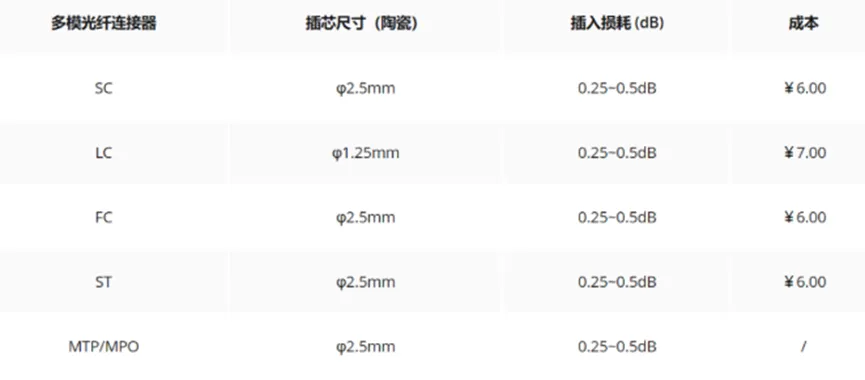
Catatan: Ferrule adalah elemen silinder yang disejajarkan secara tepat di steker konektor serat optik, dengan lubang mikroskopis di tengahnya untuk mengamankan serat optik. Tergantung pada bahan yang digunakan, ferrule dapat dikategorikan sebagai keramik, kaca, plastik, atau logam.
3. Keuntungan dari serat multimode
Meskipun serat mode tunggal memiliki keunggulan dalam bandwidth dan jarak transmisi, serat multimode dapat mendukung persyaratan jarak transmisi sebagian besar aplikasi dalam ruangan dan pusat data, dan biaya pemasangan dan perawatannya jauh lebih rendah daripada serat mode tunggal. Selain itu, serat multimode memiliki beberapa keuntungan signifikan, seperti yang dijelaskan di bawah ini:
A lossless, jaringan backbone multi-pengguna bebas gangguan: Karakteristik terbesar dari serat multimode adalah kemampuannya untuk membawa beberapa sinyal optik secara bersamaan pada tautan yang sama. Lebih penting lagi, daya sinyal optik hampir tidak ada artinya. Oleh karena itu, pengguna jaringan dapat mengirim beberapa paket data secara bersamaan melalui kabel tambalan serat multimode, dan semua informasi akan ditransmisikan dengan aman ke tujuannya tanpa gangguan dan utuh.
Dukungan untuk beberapa protokol: Serat multimode mendukung berbagai protokol transmisi data, termasuk Ethernet, InfiniBand, dan Internet Protocol. Oleh karena itu, serat multimode dianggap sebagai dasar untuk mengimplementasikan aplikasi inti.
4. Bisakah serat optik multimode digunakan sebagai mode tunggal?
Tidak, karena serat optik multimode memiliki dispersi dan kehilangan yang besar, sinyal optik tidak dapat ditransmisikan dalam jarak jauh pada serat optik multimode.


