

 English
 Español
 Português
 لالعربية
 Русский
 Bahasa Indonesia
 Français
 Türkçe
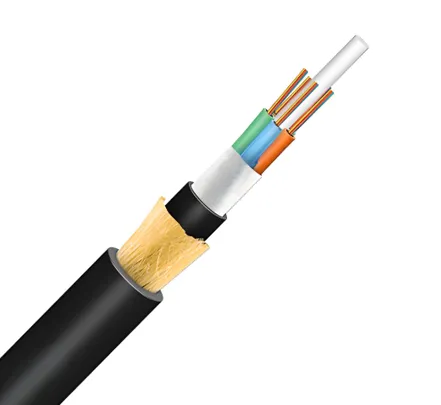
ADSS All Dielectric Self-Supporting Optical Fiber Cable ADSS cable for short is widely used in 220kV, 110kV, and 35kV voltage level transmission lines, and is generally used on existing lines. All-dielectric means that the optical cable is made of all-dielectric materials, and self-supporting means that the optical cable's own reinforcement components can withstand its own weight and external loads. The name points out the use environment of this optical cable and its key technologies: because it is self-supporting, its mechanical strength is of great importance; all-dielectric materials are used because the optical cable is in a high-voltage and strong-electric environment and must be able to withstand the influence of strong electricity; because it is used overhead on a power pole tower, it must have matching hangers to fix the optical cable on the pole tower.
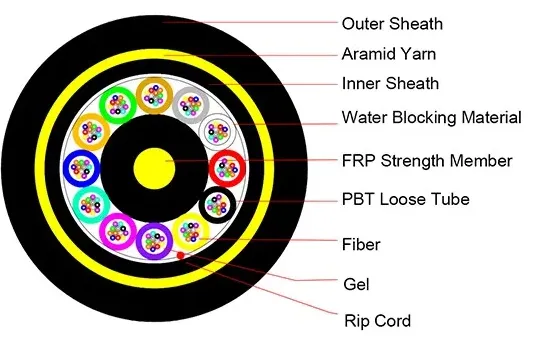
Because ADSS optical cables are installed alongside high-voltage power lines, their surface must not only be UV-resistant like conventional optical cables but also withstand the long-term demands of high-voltage, high-voltage environments. Capacitive coupling between the optical cable and the high-voltage phase line, as well as between the cable and the ground, generates different spatial potentials on the cable surface. In the presence of rain, snow, frost, and dust, this potential difference causes leakage currents to flow through the damp, dirty cable surface. The resulting thermal effect causes moisture to evaporate from certain areas of the cable surface. This transient evaporation interrupts the leakage current, generating arcs and significant heat. This accumulated heat burns the cable surface, leaving tree-like traces known as electrical tracking. Over time, the outer sheath deteriorates, and the mechanical properties of the aramid yarn deteriorate, ultimately leading to cable breakage. This problem is addressed from two primary perspectives. First, a special anti-tracking sheath material is used to extrude the outer sheath outside the aramid yarn, that is, the AT anti-tracking sheath is used to reduce the electric tracking corrosion of the optical cable surface caused by strong electricity; in addition, the spatial potential distribution on the power tower is calculated through professional software and the electric field strength distribution map is drawn. Based on this scientific basis, the specific hanging point of the optical cable on the tower is determined to avoid the optical cable being affected by a stronger electric field. ADSS optical cables use different sheaths for different power routes. The two most common ADSS sheaths are PE sheath and AT sheath. PE sheath, an ordinary polyethylene sheath, is used for power lines of 350KV and below. AT sheath, an anti-tracking sheath, is used for power lines of 110KV and above.


