

 Español
 Português
 لالعربية
 Русский
 Bahasa Indonesia
 Français
 Türkçe
 Bahasa Melayu
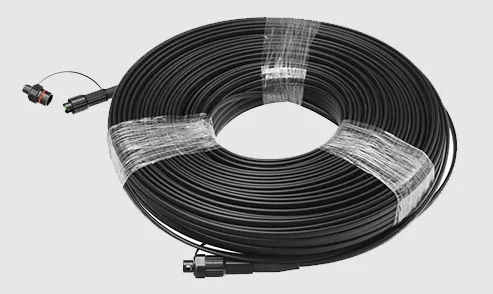
In network cabling projects, fiber optic splicing and termination are typically the most time-consuming, expensive, and technically demanding steps. Improper handling can lead to severe signal loss or even network outages.
To address this pain point, pre-terminated fiber optical cables have emerged. This "plug-and-play" solution is rapidly changing the way fiber optics are deployed in data centers, enterprise networks, and even homes.
This article will delve into what pre-terminated fiber optic cables are, how they differ from traditional field termination, and why they may be the best choice for your next project.
What are Pre-Terminated Fiber Optic Cables?
Pre-Terminated Fiber Optic Cables refer to optical cable assemblies in which the manufacturer has already completed the grinding, assembly, and testing of fiber optic connectors (such as LC, SC, MPO, etc.) before the cables leave the factory.
Simply put, when this fiber optic cable is delivered to you, it is already like an extra-long pre-made network cable with connectors at both ends. You don't need to do any cutting, grinding, or splicing; you can just plug it into your device and use it.
Key features:
Factory-grade grinding ensures extremely low insertion loss.
Plug-and-Play: No specialized fiber optic tools required.
100% tested: Passes rigorous optical performance testing before leaving the factory.
Pre-terminated vs. Field-terminated: A Comprehensive Comparison
To help you make a decision, we have compared pre-terminated fiber optical cables with traditional field termination/fusion splicing.
This is the part that Google search users care about most. The following table clearly shows the differences between the two:
| Comparison Dimensions | Pre-terminated Fiber Optic Cables | Field Termination |
| Deployment speed | Extremely fast (reduces installation time by 70-80%) | Slow (requires wire stripping, cutting, welding, and protection) |
| Technical threshold | Low cost (can be operated by ordinary IT personnel) | High-level (requires certification for professional technicians) |
| Tool Costs | No need to buy expensive tools | High-end (requires welding machine, cutting blade, OTDR, etc.) |
| performance quality | Extremely high and stable (factory environment control) | Depends on the skill level of the technician; susceptible to environmental dust. |
| flexibility | Lower (length must be measured accurately in advance) | Height (can be cut to any length on-site) |
Key takeaway: If your project has a tight schedule, lacks professional splicing equipment, or has relatively fixed cabling distances, pre-terminated fiber optical cables are the clear winner.
Why choose pre-terminated optical cables? Three major advantages.
1. Significantly reduces total cost of ownership (TCO)
Although the unit price of pre-terminated fiber optic cable may be slightly higher than that of bare fiber, it saves on expensive fusion splicer rental fees, consumable costs, and high professional labor costs. Overall, the total project cost is often lower.
2. Eliminate installation risks
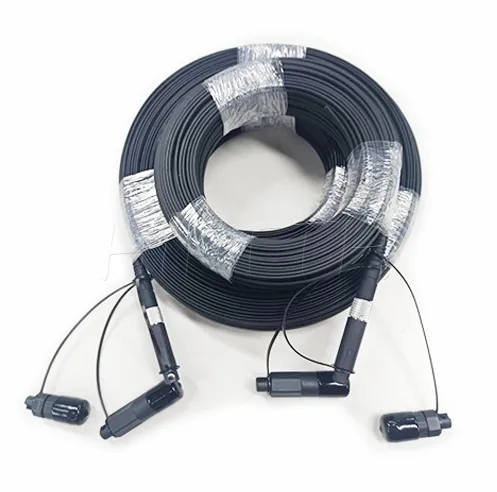
Field splicing is easily affected by dust, humidity, and human error. Pre-terminated Fiber Optic Cables are manufactured in a cleanroom, completely eliminating these uncertainties and ensuring the stability of network transmission.
3. Rapid disaster recovery
When critical lines are damaged and need to be replaced, pre-terminated fiber optic cables can restore the connection within minutes without waiting for a fusion splicing team to arrive on site with heavy equipment.
Buying Guide: How to Avoid Pitfalls?
purchasing pre-terminated fiber optical cables , extra care is needed due to their non-cuttable nature. Please follow these steps:
Step 1: Accurately measure the length (crucial!)
This is the most important point. Because pre-terminated optical cables cannot be cut or spliced on-site.
Recommendation: Always add 5-10% redundancy to the measured distance to accommodate bends, fiber coiling, and future equipment relocation. Better too long than too short!
Step 2: Select the correct connector type
Please confirm the type of interface your switch or optical module uses:
LC: Most commonly found in SFP modules, high-density environments.
SC: Commonly found in media converters or older devices.
MPO/MTP: Used for 40G/100G high-speed data center interconnects.
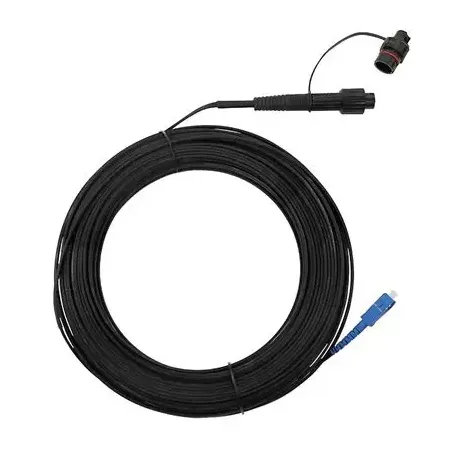
Step 3: Follow "Pulling Eye"
If you need to run fiber optic cables through conduits or cable trays, be sure to ask the manufacturer to install a Pulling Eye . This is a protective device that can withstand pulling forces and protects the fragile fiber optic connectors from damage during installation.
FAQ
frequently searched questions about Pre-Terminated Fiber Optic Cables :
Q1: Can pre-terminated fiber optical cables be cut?
Absolutely not. Once you cut it, you've removed the factory-ground end face, rendering the fiber optic cable unusable unless you have specialized fusion splicing tools to re-terminate it in the field, which defeats the purpose of purchasing a pre-terminated product.
Q2: Is this type of fiber optic cable suitable for outdoor use?
Yes, but only if you purchase pre-terminated fiber optic cables that are **outdoor-rated** or **armored**. Ordinary indoor fiber optic cables cannot withstand UV radiation and rain.
Q3: How long is its lifespan?
Under normal installation and without frequent plugging and unplugging, its service life is the same as that of standard optical cables, typically reaching 10-20 years or more.
Summarize
With increasing demands for network speeds and a shortage of skilled workers, pre-terminated fiber optical cables are no longer just an "alternative solution," but rather the preferred standard for many data centers and enterprise networks. They offer significant time savings and enhanced reliability at the cost of slightly reduced length flexibility.


