

 English
 Español
 Português
 لالعربية
 Bahasa Indonesia
 Français
 Türkçe
 Bahasa Melayu
The working principle of fiber optic cables is primarily based on the phenomenon of Total Internal Reflection (TIR) in physics.This mechanism allows light signals to travel long distances with extremely low loss along a thin glass or plastic fiber.
Core Mechanism of Fiber Optic Working Principle
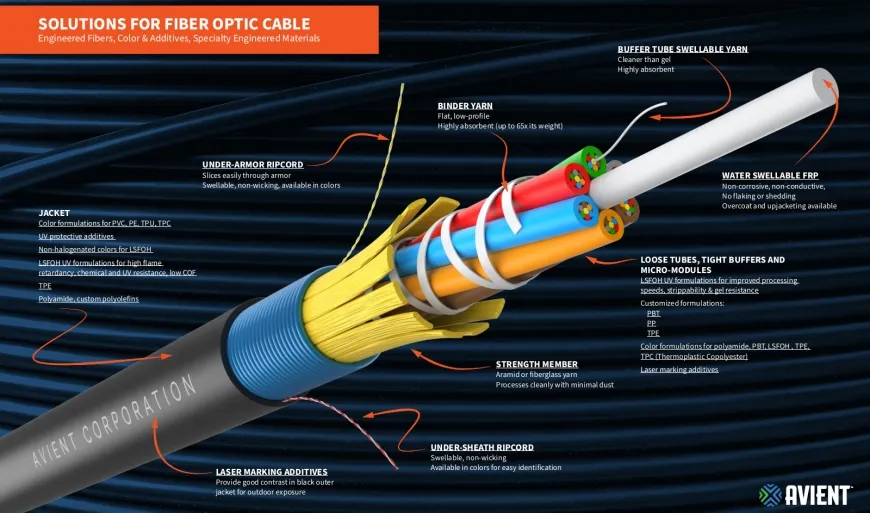
fiber optic cables consist of three basic parts that work together to achieve TIR:
1. The Structure:
Components, Materials and Functions, Key Optical Characteristics
Core: Located at the center of the fiber, it is the path for light signal transmission and is typically made of high-purity glass (silicon dioxide). It has a high refractive index
Cladding: A layer of material surrounding the core, also made of glass but doped with different substances. It has a lower refractive index
Buffer Coating: An outer plastic protective coating used to protect the fragile glass fiber from physical damage and moisture. Provides only mechanical protection and does not participate in optical signal transmission.
2. Total Internal Reflection (TIR)
This is the core physical principle of fiber optic operation:
• Refractive index difference: The speed of light differs in different media. The refractive index ($n$) is an indicator of the speed of light in a given medium. Fiber optic design utilizes the slight difference in refractive index between the core ($n_1$) and the cladding ($n_2$) (the core has a slightly higher refractive index).
• Light incidence: When an optical signal (usually generated by a laser or LED) enters the fiber core at a specific angle, it propagates along the core until it encounters the core-cladding interface.
• Total reflection: Because light travels from a medium with a higher refractive index (core) to a medium with a lower refractive index (cladding), and the angle of incidence is greater than a specific critical angle, the optical signal will not penetrate into the cladding but will be completely reflected back to the core.
This continuous, mirror-like reflection process allows the light signal to propagate forward along a winding path, much like in a pipe, until it reaches the receiving end.
3. Data Transmission Process
Optical fiber communication systems convert electrical signals into optical signals, transmit them through optical fibers, and finally convert the optical signals back into electrical signals at the receiving end:
Transmitter: Converts digital data (1s and 0s) into light pulses (light on/off), typically using a laser diode (LD) or light-emitting diode (LED) as the light source.
2. Optical Fiber: The light pulses propagate at high speed and over long distances along the core of the optical fiber through total internal reflection. 13
3. Receiver: After receiving the light pulses, a photodiode or phototransistor converts them back into digital electrical signals for processing by the equipment.
Why is optical fiber better than copper cable?
Optical fiber has become the preferred choice for modern communication due to its inherent advantages based on optical transmission:
• High bandwidth: The frequency of light waves is much higher than that of electromagnetic waves, allowing optical fibers to carry millions of times more data than copper cables.
• Low loss: The high-purity glass core has extremely low attenuation (e.g., typical single-mode fiber has a loss of less than $0.2 dB per kilometer), allowing signals to travel tens of kilometers without amplification.
• Interference immunity: Optical signals are unaffected by electromagnetic interference (EMI) or radio frequency interference (RFI), ensuring signal stability and reliability.


