

 Español
 Português
 لالعربية
 Русский
 Bahasa Indonesia
 Français
 Türkçe
 Bahasa Melayu
Snippet Optimization
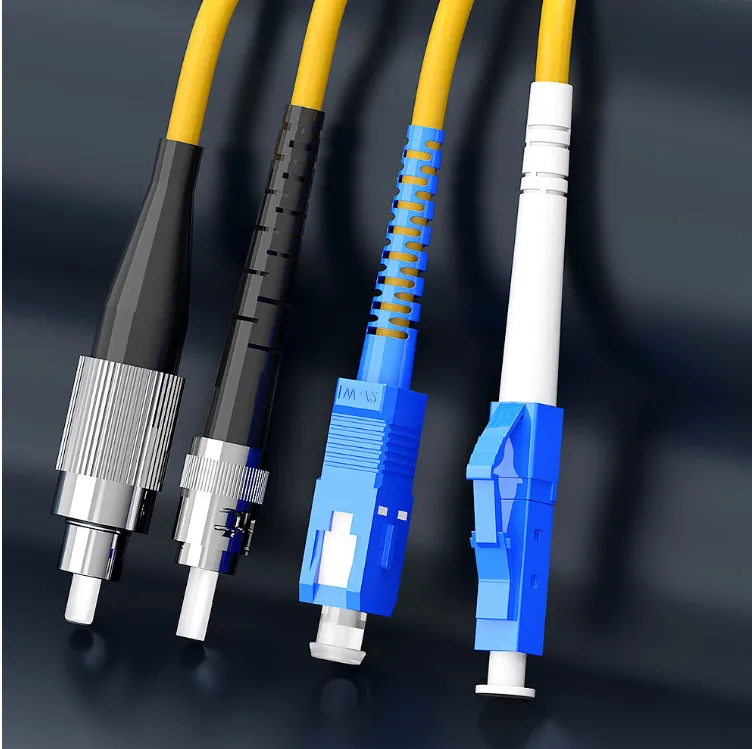
A fiber-to-fiber connector, also known as a cable connector or fiber splice, is a device used to permanently or temporarily connect optical fibers to enable efficient transmission of optical signals. It uses a high-precision ferrule and alignment sleeve to tightly align the end faces of two optical fibers, minimizing optical signal loss. Common types include LC, SC, and MPO/MTP , and are widely used in telecommunications, data centers, and enterprise networks.
1. The core role of fiber optic connectors
Fiber optic connectors are essential components in optical communication systems. They provide a fast, repeatable, and splice-free method for connecting and disconnecting fiber optic links. The connector's primary goal is to ensure precise alignment of the fiber cores, resulting in low insertion loss and high return loss , ensuring high-quality optical signal transmission.
2. Main fiber optic connector types
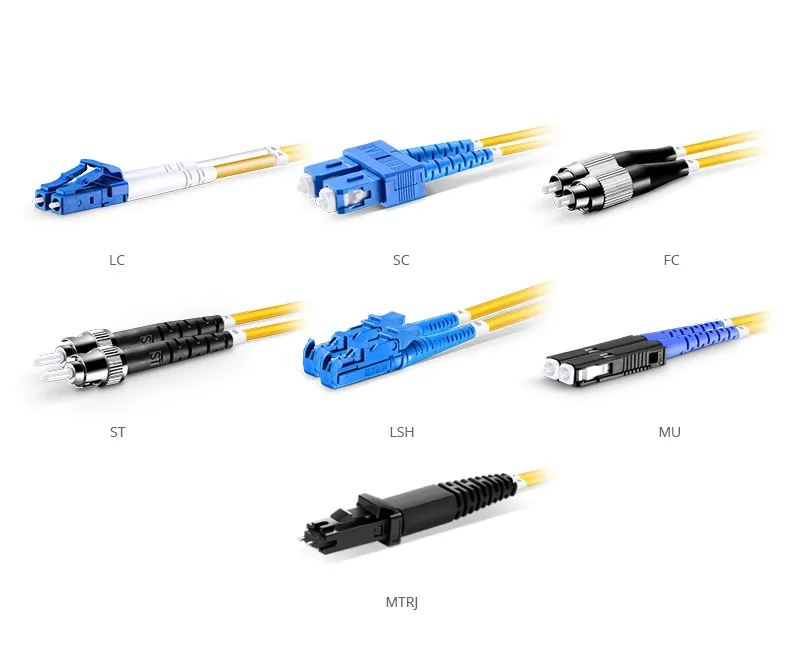
There are about a hundred types of fiber optic connectors on the market, but the most common and widely used ones are mainly the following:
| Connector Type | Key Features | Ferrule size | Typical application scenarios |
| LC (Lucent Connector) | Small Form Factor (SFF), Latch mechanism | 1.25 mm | Data center, high-density patch panel, SFP/SFP+ transceiver |
| SC (Subscriber Connector) | Push-Pull mechanism, excellent performance | 2.5 mm | Telecommunications networks, passive optical networks (PON), point-to-point connections |
| ST (Straight Tip) | Bayonet connection, spring loaded | 2.5 mm | Early multi-mode applications, enterprise networks, and military applications |
| MPO/MTP (Multi-fiber Push On) | Multi-fiber (4 to 144 cores), high-density design | N/A | Ultra-high-density data centers, 40G/100G/400G parallel optical transmission |
3. Connector polish type
The end face polish of fiber optic connectors is a key factor affecting performance and is mainly divided into three categories:
- PC (Physical Contact) : The end face is slightly convex to reduce the air gap.
- UPC (Ultra Physical Contact) : Has a finer finish than PC and higher return loss (less signal reflection).
APC (Angled Physical Contact) : The endface is polished at an 8-degree angle. This is the best choice for achieving extremely low return loss (>60 dB) and is often used in single-mode applications with extremely high reflection requirements, such as CATV and FTTX.
4. How do I choose the right fiber optic connector?
Choosing the right fiber optic connector requires considering the following factors:
- Density requirements : In high-density environments (such as data centers), LC (smallest size) and MPO/MTP (multi-fiber) are preferred.
- Network Type : Telecom and PON networks often use SC and APC polished connectors.
- Fiber Mode :
- Single-Mode : The core diameter is thin (about 9 μm ), suitable for long-distance transmission, usually with UPC or APC polishing.
- Multi-Mode : Core diameter is 50 μm or 62.5 μm , suitable for short-distance transmission, usually with PC or UPC polishing.
Frequency of connection and disconnection : The push-pull/snap-on design of LC and SC provides quick connection capability.
in conclusion
Fiber optic connectors are the foundation of modern high-speed networks. With the continuous growth of data traffic and the increasing density of data centers, LC and MPO/MTP connectors are becoming industry standards. Understanding the characteristics and applications of different connectors is key to designing, deploying, and maintaining efficient fiber optic networks.
Q&A
Q: What is the main function of a fiber optic connector?
A: Its primary function is to terminate the ends of optical fibers and enable faster connections and disconnections than fusion splicing, ensuring efficient and accurate transmission of optical signals between two optical fibers.
Q: What is the core component of a fiber optic connector? What is its function?
A: The core component is the ferrule. It is a cylindrical structure that secures the optical fiber and ensures precise alignment of the fiber cores, allowing light to pass smoothly.
Q: What are the common types of fiber optic connectors on the market?
A: Common connector types include SC (square), LC (low profile), ST (bayonet), and MTP/MPO.
Q: Why do fiber optic connections require higher precision than cable connections?
A: Because optical fibers transmit light pulses rather than electrical signals, connectors must perfectly align the two tiny glass or plastic fiber cores to minimize optical signal loss (insertion loss).
Q: What applications are fiber optic connectors commonly used in?
A: They are widely used in telecommunication switching offices, data centers, computer networks, fiber-to-the-home (FTTH), cable television (CATV) networks, and various sensors and industrial applications.


